
As unmanned aerial vehicles (UAVs) expand beyond hobbyist use into industrial inspection, mapping, logistics, agriculture, and defense, endurance has become a defining performance metric. Traditional battery-powered drones dominate the market due to simplicity and low cost, but fuel cell drone systems are increasingly gaining attention for missions that require hours rather than minutes of flight time.
This article provides a technical and objective comparison of battery-powered drones and fuel cell-powered drones, focusing on endurance, efficiency, payload capability, operating cost, and real-world applications. The goal is to help UAV developers, system integrators, and operators determine which power solution is best suited for long-endurance drone missions.
Understanding Power Systems in Long-Endurance Drones
What Defines “Long-Endurance” in UAVs?
Long-endurance drones typically operate beyond 60–90 minutes of continuous flight, with some industrial platforms targeting 3–10 hours or more. Achieving this level of endurance depends heavily on:
- Energy density of the power source
- Power-to-weight ratio
- System efficiency and thermal management
- Payload and flight profile
Both lithium-based batteries and hydrogen fuel cells address these challenges differently.
Battery-Powered Drones: Strengths and Limitations
How Battery Drone Power Systems Work
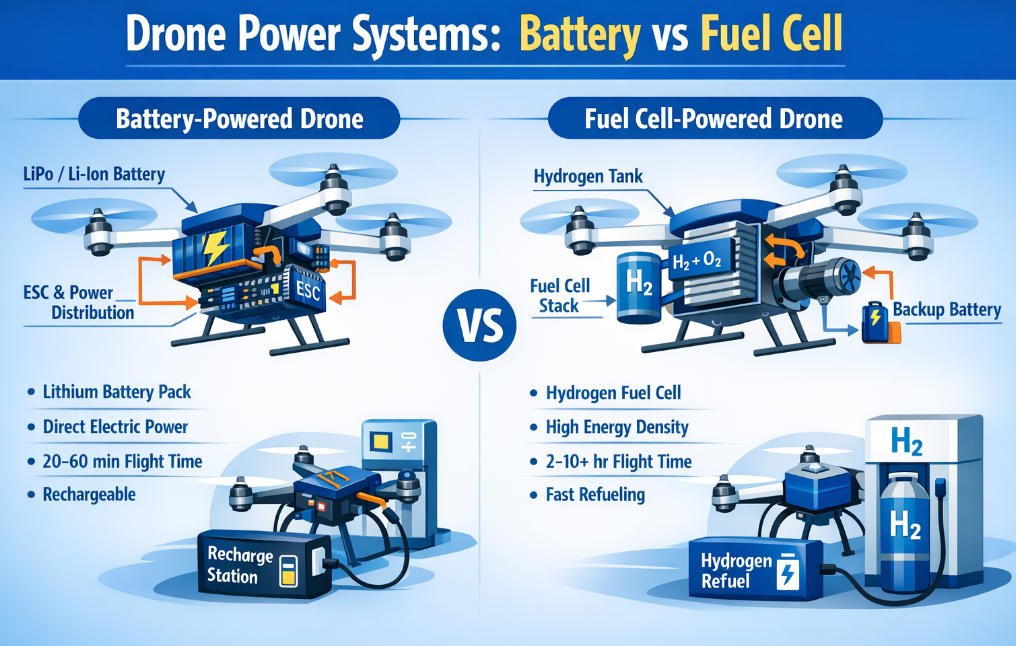
Battery-powered UAVs typically rely on lithium polymer (LiPo) or lithium-ion (Li-ion) batteries. These batteries store electrical energy chemically and deliver power directly to motors through electronic speed controllers.
Advantages of Battery-Powered Drones
Battery systems remain the dominant choice for short- to medium-endurance UAVs due to several advantages:
- Simple architecture with minimal auxiliary components
- Low upfront cost and mature supply chains
- High reliability and predictable performance
- Quiet operation, beneficial for urban or environmental missions
Battery drones are well suited for:
- Aerial photography and videography
- Short-range surveying
- Training and rapid deployment scenarios
Limitations for Long-Endurance Missions
Despite their popularity, batteries face fundamental constraints:
- Low gravimetric energy density compared to fuel-based systems
- Long recharge times relative to refueling
- Performance degradation over repeated charge cycles
- Weight increases linearly with added capacity
For long-endurance drones, simply adding more batteries often leads to diminishing returns due to increased mass and reduced aerodynamic efficiency.
Fuel Cell Drones: A Solution for Extended Flight Time
How Fuel Cell UAV Systems Work
Fuel cell drones generate electricity through an electrochemical reaction, typically using hydrogen as fuel. Instead of storing energy directly like batteries, fuel cells convert fuel into electricity on demand, producing water and heat as byproducts.
Most UAV fuel cell systems are hybrid architectures, combining:
- A fuel cell for steady cruise power
- A small battery for peak loads (takeoff, maneuvering)
Advantages of Fuel Cell Drones for Long Endurance
Fuel cell technology offers several key benefits for endurance-focused UAV platforms:
- Significantly higher energy density than lithium batteries
- Flight times measured in hours, not minutes
- Fast refueling, often within minutes
- Consistent voltage output, improving power stability
- Reduced total system weight for long missions
These characteristics make fuel cell drones well suited for:
- Long-range mapping and corridor inspection
- Border patrol and surveillance
- Maritime monitoring
- BVLOS (Beyond Visual Line of Sight) operations
Technical and Operational Challenges
Despite their advantages, fuel cell UAVs also present challenges:
- Higher initial system cost
- More complex integration, including hydrogen storage and control systems
- Limited hydrogen infrastructure in some regions
- Special handling and safety requirements
As a result, fuel cell drones are typically deployed in professional or industrial environments, rather than consumer markets.
Battery vs Fuel Cell: Side-by-Side Comparison
| Feature | Battery-Powered Drones | Fuel Cell-Powered Drones |
|---|---|---|
| Typical Flight Time | 20–60 minutes | 2–10+ hours |
| Energy Density | Low–Medium | Very High |
| Refueling / Recharging | Slow (30–120 min) | Fast (minutes) |
| System Complexity | Low | Medium–High |
| Initial Cost | Lower | Higher |
| Maintenance | Simple | Moderate |
| Best Use Case | Short missions, low cost | Long endurance, BVLOS |
Which Power System Is Best for Long-Endurance Drones?
Choose Battery Power If:
- Missions are short or moderate in duration
- Cost sensitivity is a priority
- Simplicity and rapid deployment matter
- Infrastructure for hydrogen is unavailable
Choose Fuel Cell Power If:
- Maximum flight time is critical
- Missions require long-range or persistent coverage
- Payload efficiency must be optimized
- Refueling speed is more important than recharge cycles
For many advanced UAV platforms, hybrid power solutions that combine fuel cells and batteries are emerging as an optimal compromise, balancing endurance, responsiveness, and reliability.
Future Trends in UAV Power Technology
As UAV applications continue to expand, power systems are evolving rapidly:
- Improvements in hydrogen storage materials
- Higher-efficiency proton exchange membrane (PEM) fuel cells
- Smarter energy management systems
- Lightweight composite tanks and modular power architectures
These developments are expected to further strengthen the role of fuel cell technology in next-generation long-endurance drones, particularly for industrial and commercial use.
Conclusion
When comparing battery vs fuel cell power systems for long-endurance drones, there is no universal solution. Batteries remain ideal for simplicity, affordability, and short missions, while fuel cells excel in applications where endurance, efficiency, and operational range are critical.
Selecting the right UAV power system depends on mission requirements, operating environment, cost constraints, and endurance goals. As technology matures, fuel cell drones are likely to play an increasingly important role in the future of long-endurance UAV operations.

0 Comments