
Unmanned Aerial Vehicles (UAVs) rely heavily on advanced battery technology to achieve safe, efficient, and reliable flight. While much attention is given to battery chemistry and capacity, the Battery Management System (BMS) plays an equally critical role. A well-designed UAV BMS ensures battery safety, optimizes performance, and extends service life—especially in demanding aerial applications.
This article provides a comprehensive overview of UAV Battery Management Systems, explaining how they work, why they matter, and what design considerations are essential for modern drone platforms.
What Is a UAV Battery Management System?
A UAV Battery Management System is an integrated electronic system that monitors, protects, and manages rechargeable batteries used in drones. It continuously collects data on battery operating conditions and enforces control strategies to keep the battery within safe limits during charging, discharging, and storage.
In UAV applications, BMS solutions are typically optimized for high power density, lightweight design, and real-time responsiveness, making them more specialized than BMS units used in ground-based energy storage systems.
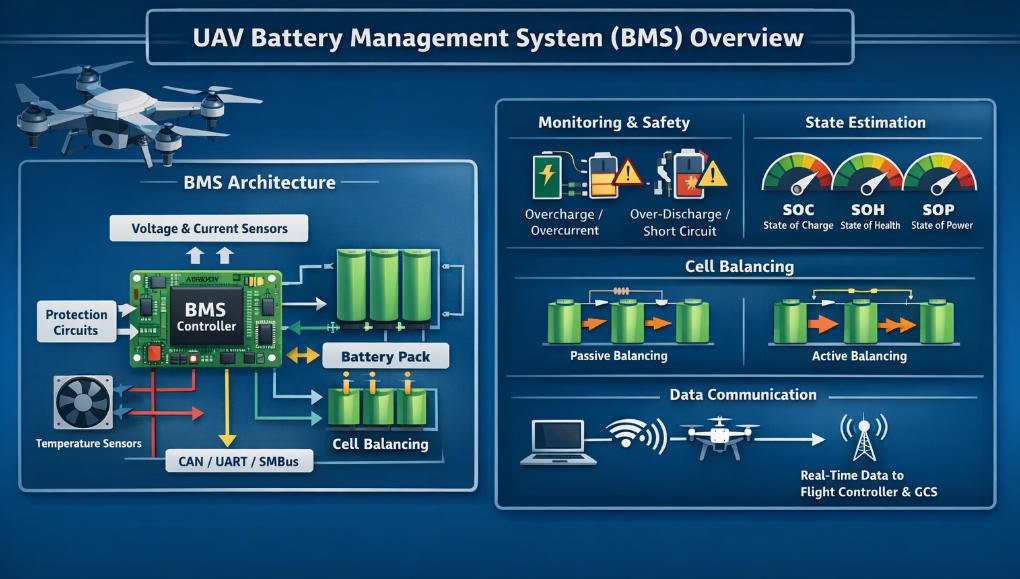
Core Functions of a UAV BMS
1. Voltage and Current Monitoring
The BMS tracks individual cell voltages and overall pack voltage to prevent:
- Over-charging
- Over-discharging
- Voltage imbalance between cells
Accurate current sensing is also essential for power estimation and load management during flight.
2. Battery Protection Mechanisms
A UAV BMS provides multiple layers of protection, including:
- Overcurrent protection
- Short-circuit protection
- Over-voltage and under-voltage cutoffs
- Thermal shutdown in extreme conditions
These protections are critical for flight safety, especially during high-load maneuvers such as takeoff, climb, and rapid acceleration.
3. Cell Balancing
Cell imbalance can reduce usable capacity and accelerate battery degradation. UAV BMS units typically use:
- Passive balancing for simplicity and weight reduction
- Active balancing in high-end or long-endurance UAV systems
Balancing ensures uniform cell aging and consistent performance over the battery’s lifecycle.
4. State Estimation (SOC, SOH, SOP)
Modern UAV BMS designs calculate key battery parameters:
- State of Charge (SOC): Remaining usable energy
- State of Health (SOH): Battery aging and capacity fade
- State of Power (SOP): Maximum available output power
Accurate state estimation supports intelligent flight control decisions and mission planning.
Why BMS Is Critical for UAV Performance
Flight Safety
Battery failure is one of the most common causes of UAV accidents. A reliable BMS reduces risk by preventing unsafe operating conditions and enabling controlled shutdowns when necessary.
Battery Longevity
By managing charge/discharge cycles and thermal stress, a BMS significantly extends battery lifespan—reducing operational costs for commercial UAV fleets.
Energy Efficiency
Optimized energy utilization allows UAVs to achieve longer flight times and more stable power delivery, especially in long-endurance or heavy-payload missions.
Key Design Considerations for UAV BMS
Lightweight and Compact Design
Weight directly impacts UAV endurance. UAV BMS hardware must balance functionality with minimal mass and volume.
High Discharge Capability
UAV power systems often experience high peak currents. The BMS must handle rapid current changes without latency or signal distortion.
Communication Interfaces
Common UAV BMS communication protocols include:
- CAN bus
- UART
- SMBus
These interfaces allow real-time data exchange with flight controllers and ground control systems.
Environmental Adaptability
UAVs operate in diverse environments. A robust BMS should tolerate:
- Wide temperature ranges
- Vibration and mechanical shock
- Electromagnetic interference (EMI)
BMS and UAV Battery Chemistries
While lithium-polymer (Li-Po) batteries are widely used in UAVs, lithium-ion and emerging solid-state technologies are gaining adoption. A flexible BMS design must accommodate:
- Different voltage profiles
- Charge characteristics
- Thermal behaviors
Battery chemistry and BMS design must be matched to ensure optimal performance and safety.
Future Trends in UAV BMS Technology
- AI-based state estimation for more accurate SOC prediction
- Smart diagnostics for predictive maintenance
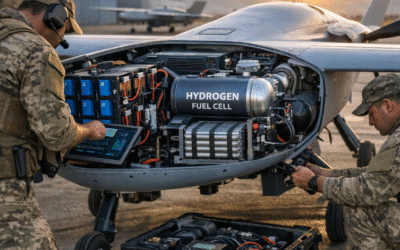
- Integration with hybrid and fuel-cell UAV systems
- Enhanced data logging for fleet management and compliance
As UAV missions become more complex, intelligent BMS solutions will be a foundational component of next-generation drone power systems.
Conclusion
Understanding UAV Battery Management Systems is essential for anyone involved in drone design, manufacturing, or operation. A well-engineered BMS not only protects the battery but also enhances flight safety, improves energy efficiency, and extends system longevity. As UAV applications continue to expand across industrial, commercial, and research sectors, the role of advanced BMS technology will only become more critical.


0 Comments