
Unmanned Aerial Vehicles (UAVs) are increasingly deployed across long-endurance surveillance, mapping, logistics, industrial inspection, and defense-related missions. At the core of UAV performance lies the engine or propulsion system, whose characteristics directly determine flight endurance, payload capacity, reliability, and operational cost.
To design, select, or integrate an appropriate UAV engine, engineers must understand key performance metrics rather than relying on headline power ratings alone. This article provides a detailed explanation of the most critical UAV engine performance metrics, their engineering significance, and how they influence real-world UAV mission profiles.
1. Power Output and Power-to-Weight Ratio
Rated Power Output
Power output, typically expressed in kilowatts (kW) or horsepower (HP), defines the maximum mechanical energy an engine can deliver to the propeller or generator. For UAVs, continuous rated power is often more important than peak power, as most missions involve long-duration cruise rather than short bursts.
Power-to-Weight Ratio
The power-to-weight ratio (kW/kg) is one of the most critical metrics for UAV engines. A higher ratio allows:
- Increased payload capacity
- Improved climb performance
- Lower overall airframe mass
In UAV design, excess engine weight directly reduces endurance and operational efficiency, making lightweight engine architecture a priority.
2. Fuel Efficiency and Specific Fuel Consumption (SFC)
Specific Fuel Consumption (SFC)
SFC measures how much fuel an engine consumes to produce a unit of power, usually expressed as:
- g/kWh or kg/kWh
Lower SFC values indicate higher efficiency, translating directly into:
- Longer flight endurance
- Reduced fuel load
- Lower operational cost
Cruise Efficiency vs. Maximum Efficiency
UAV engines are typically optimized for steady-state cruise efficiency rather than high-speed performance. Engines with a flat efficiency curve across a broad RPM range are particularly valuable for variable mission profiles.
3. Endurance Contribution and Energy Density
Fuel Type and Energy Density
The energy density of the fuel plays a major role in UAV endurance:
- Gasoline and heavy fuels provide significantly higher energy density than batteries
- Hybrid systems leverage fuel energy density with electric efficiency
Engine Role in Endurance UAVs
For long-endurance UAVs, engines may function as:
- Direct propulsion systems
- Hybrid generators
- Range extenders
In each configuration, the engine’s efficiency at constant load becomes a dominant performance metric.
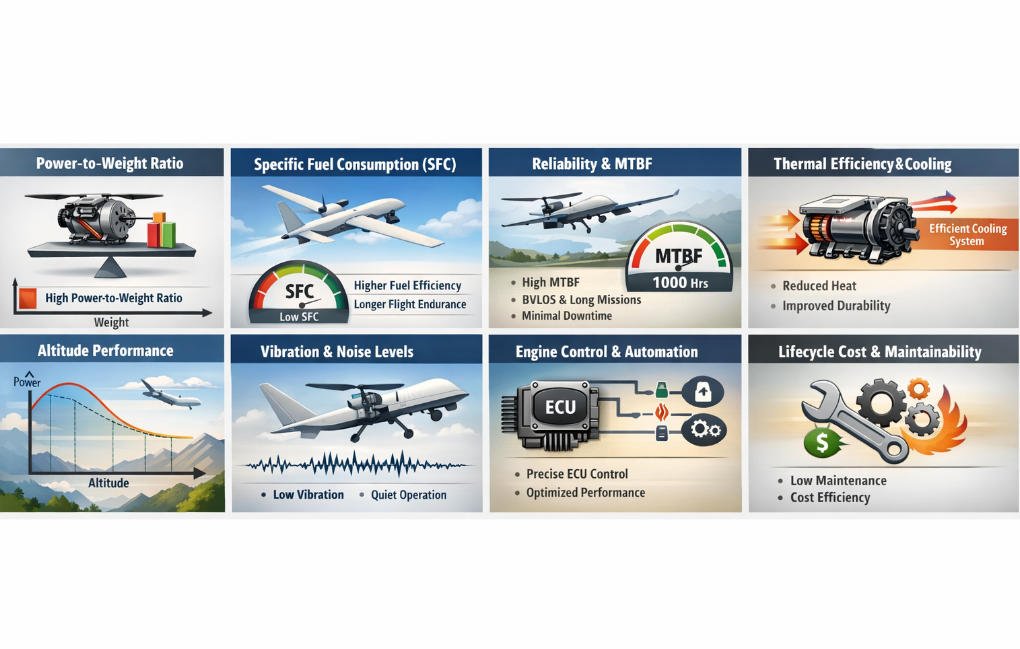
4. Reliability and Mean Time Between Failures (MTBF)
Reliability Metrics
Reliability is often quantified through:
- MTBF (Mean Time Between Failures)
- Scheduled maintenance intervals
- Operational hours between overhauls
High-reliability engines are essential for:
- Beyond Visual Line of Sight (BVLOS) operations
- Remote or inaccessible mission areas
- Long-duration autonomous flights
Design Factors Affecting Reliability
Key contributors include:
- Simplified mechanical architecture
- Thermal stability
- High-quality materials and tolerances
- Redundant ignition or control systems
5. Thermal Efficiency and Heat Management
Thermal Efficiency
Thermal efficiency reflects how effectively an engine converts fuel energy into usable mechanical power. Poor thermal efficiency leads to:
- Excess heat generation
- Reduced component lifespan
- Higher cooling system weight
Cooling System Integration
UAV engines must balance:
- Adequate cooling capacity
- Minimal aerodynamic drag
- Lightweight thermal management components
Efficient thermal design directly improves endurance and system reliability.
6. Altitude Performance and Power Derating
Air Density Effects
As altitude increases, air density decreases, reducing:
- Combustion efficiency
- Available oxygen
- Propeller thrust
Power Derating Curves
Well-designed UAV engines provide predictable power derating curves, allowing engineers to:
- Model high-altitude performance accurately
- Maintain stable output in ISR and mapping missions
- Avoid engine overloading
Engines optimized for high-altitude UAVs often include advanced intake, fuel control, or turbocharging strategies.
7. Vibration, Noise, and Acoustic Signature
Vibration Levels
Excessive vibration can:
- Degrade sensor accuracy
- Damage avionics and airframe structures
- Increase maintenance frequency
Balanced rotating components and optimized combustion timing are essential for vibration control.
Acoustic Performance
Low acoustic signature is increasingly important for:
- Surveillance and reconnaissance missions
- Urban and industrial inspection
- Wildlife monitoring
Engine noise characteristics must be evaluated alongside propeller and airframe acoustics.
8. Engine Control Systems and Automation
ECU and Engine Management
Modern UAV engines rely on Electronic Control Units (ECUs) to manage:
- Fuel injection
- Ignition timing
- Load matching
- Fault detection
Advanced control systems improve:
- Fuel efficiency
- Engine responsiveness
- Autonomous flight reliability
Integration with UAV Systems
Engine data must integrate seamlessly with:
- Flight control systems
- Power management units
- Ground control stations
9. Lifecycle Cost and Maintainability
Total Cost of Ownership (TCO)
Beyond purchase price, UAV engine evaluation should consider:
- Fuel consumption over mission life
- Maintenance labor and spare parts
- Downtime and service intervals
Maintainability
Engines designed with modular components and simplified access reduce:
- Field maintenance time
- Operational interruptions
- Long-term operating costs
Understanding UAV engine performance requires a system-level perspective, not just power ratings or marketing claims. Metrics such as specific fuel consumption, power-to-weight ratio, reliability, thermal efficiency, and altitude performance collectively define how well an engine supports real-world UAV missions.
For engineers, manufacturers, and operators, selecting the right UAV engine means aligning these performance metrics with mission objectives, environmental conditions, and lifecycle cost expectations. A data-driven, application-focused approach ensures optimal performance, reliability, and efficiency across diverse UAV platforms.

0 Comments