
The rapid evolution of unmanned aerial systems (UAS) has transformed industries from defense to agriculture and commercial logistics. As UAS become more capable, propulsion integration—the process of aligning the propulsion system with overall aircraft architecture—emerges as a critical engineering priority. This article explores the technical challenges associated with propulsion integration in modern UAS and highlights strategies to achieve efficient, reliable, and scalable systems.
1. Overview of Propulsion Integration in UAS
Propulsion integration refers to the seamless incorporation of engines, motors, propellers, power electronics, energy storage, and control systems into a UAS platform. Successful integration ensures that the propulsion system supports mission requirements while maximizing performance, endurance, and safety.
In modern UAS, propulsion components must work in concert with avionics, sensors, communication modules, and payloads. This complexity introduces several challenges that, if not addressed, can degrade performance, reduce reliability, and limit operational capabilities.
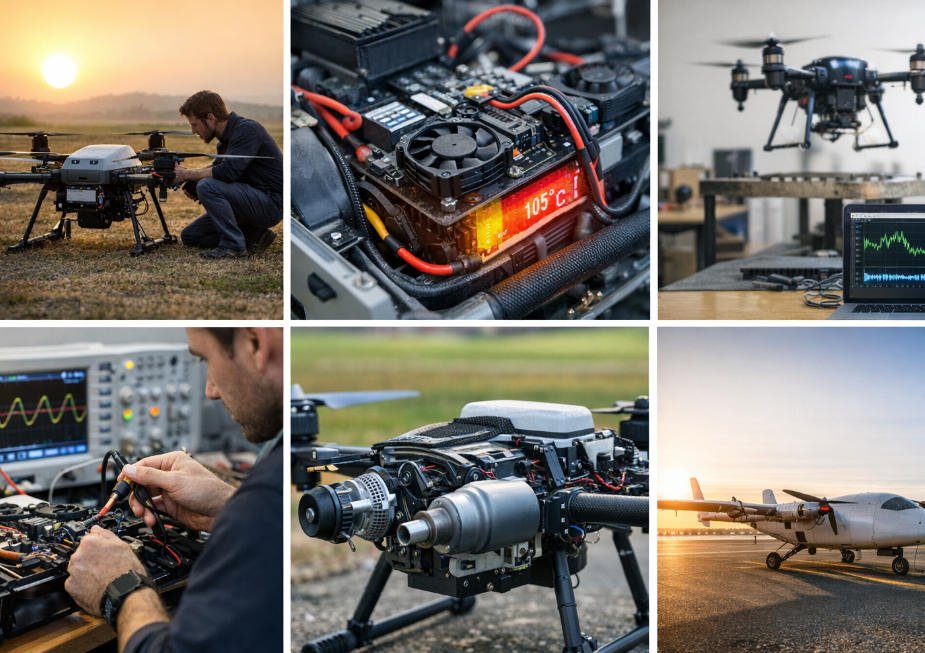
2. Power Density vs. Weight Constraints
One of the foremost challenges in UAS propulsion integration is balancing power density with weight limitations.
- Lightweight Materials and Compact Systems: Designers must select components that deliver high power without increasing the platform’s mass. Battery energy density remains a bottleneck in electric propulsion systems, while combustion engines add weight due to fuel systems and mechanical components.
- Optimization Strategies: Using advanced composite materials, integrating lightweight power electronics, and exploring high-density energy storage options help mitigate weight penalties.
This challenge directly affects flight endurance, payload capacity, and maneuverability, making it central to propulsion integration success.
3. Thermal Management Challenges
Propulsion systems generate significant heat—whether from electric motors, power electronics, or internal combustion engines. Effective thermal management is vital for maintaining performance and preventing failures.
Key Issues:
- Heat Dissipation: In compact UAS designs, limited airflow can restrict heat removal.
- Component Sensitivity: Batteries, ESCs (Electronic Speed Controllers), and motors can degrade rapidly under elevated temperatures.
Solutions:
- Passive cooling techniques (heat sinks and thermally conductive structures).
- Active cooling systems (micro-fans or liquid cooling) for high-power applications.
- Thermal modeling during design phases to predict and mitigate hotspots.
Efficient thermal management enhances system reliability and extends component life.
4. Vibration, Resonance, and Structural Compatibility
Propulsion components introduce vibration and mechanical resonance that can affect UAS stability and avionics performance.
- Sources of Vibration: Misaligned propellers, uneven motor torque, and combustion engine cycles.
- Impact on UAS: Vibration can interfere with sensors and reduce structural integrity over time.
Integration Practices:
- Vibration-isolating mounts between propulsion units and airframe.
- Precision balancing of rotating components.
- Structural damping materials to absorb and reduce vibratory energy.
Addressing vibration is essential for stable flight performance and sensor accuracy.
5. Electromagnetic Interference (EMI) and Control Integration
Modern UAS rely on sophisticated electronics, including navigation, communication, and autopilot systems. Electromagnetic interference (EMI) from propulsion power electronics—especially in electric and hybrid systems—can disrupt critical signal paths.
Challenges:
- Power inverters and ESC switching frequencies may interfere with radio and sensor systems.
- Long power cables and shared ground paths can create noise loops.
Mitigation Strategies:
- Shielded cabling and grounded enclosures.
- EMI filtering components integrated into propulsion electronic designs.
- Separation of sensitive electronics from high-current pathways.
Careful planning of the electrical architecture ensures reliable communication and control.
6. Safety, Redundancy, and Fault Tolerance
Safety is paramount in UAS operations. Propulsion integration must incorporate redundancy and fault-tolerant designs to ensure mission success even under failure conditions.
- Redundant Propulsion Units: Multi-rotor configurations inherently provide redundancy, but fixed-wing UAS may require backup systems or emergency procedures.
- Health Monitoring Systems: Real-time monitoring of motor temperature, vibration, and power draw helps predict and prevent failures.
Safety-focused integration increases mission reliability and reduces operational risk.
7. Scalability and Future-Ready Designs
As UAS applications grow—from micro-drones to large cargo UAS—propulsion integration must be flexible and scalable.
- Modular Propulsion Units: Facilitates easy upgrades and component swaps.
- Standardized Interfaces: Allow interoperability across platforms and suppliers.
- Emerging Technologies: Hybrid and distributed electric propulsion (DEP) show promise for larger UAS with reduced emissions and increased efficiency.
Designing with future scalability in mind positions UAS manufacturers to adapt quickly to evolving standards and missions.
Propulsion integration in modern UAS is more than assembling engines and motors—it demands a systems-level approach that balances performance, reliability, safety, and future adaptability. Addressing challenges such as power-to-weight ratios, thermal management, vibration control, EMI suppression, and redundancy are key to unlocking the full potential of unmanned aerial platforms.
By investing in thoughtful propulsion integration strategies, innovators can deliver UAS solutions that are efficient, resilient, and scalable—pushing the boundaries of what unmanned aircraft can achieve.


0 Comments