
In modern defense environments, military unmanned aerial vehicles (UAVs) have become indispensable for intelligence, surveillance, reconnaissance (ISR), and tactical missions. As operational demands increase, so does the need for robust, reliable, and highly efficient power systems. Optimizing power delivery directly improves flight endurance, mission reliability, payload capability, and overall operational readiness. This article explores essential strategies and technologies for advanced power system optimization in military UAV operations.
The Critical Role of Power Systems in Military UAV Performance
Power systems are the backbone of all UAV operations. For military missions, key performance factors include:
- Flight endurance and range
- Payload power availability
- Environmental resilience
- Reliability under combat or remote conditions
Efficient power systems directly influence the success rate of missions, particularly in high-stakes defense operations where failure is not an option.
Challenges in Military UAV Power System Design
Military UAV power systems face unique and complex challenges that demand advanced solutions:
Weight Versus Energy Density Trade-off
Every kilogram added to a UAV affects its endurance and maneuverability. Traditional batteries with limited energy density can compromise mission duration. Engineers must balance power output, weight, and energy density to optimize performance.
Environmental and Operational Stress
Military UAVs may operate in extreme temperatures, high winds, and battlefield conditions. Power systems must maintain performance stability under all environmental stresses.
Maintenance and Logistics Constraints
Access to remote operational zones can hinder rapid battery replacement and power system maintenance. Hence, systems must be rugged, reliable, and low-maintenance.
Strategies for Power Optimization in Military UAVs
Achieving optimized power efficiency requires a multifaceted approach. The following strategies are critical:
Hybrid Power Architectures
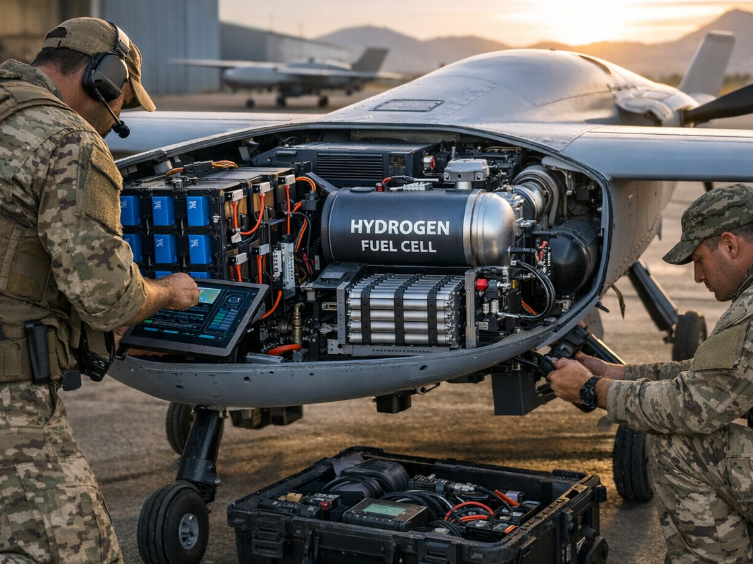
Hybrid systems — including battery-plus-fuel cell or battery-plus-micro-turbine configurations — extend mission endurance far beyond traditional battery-only designs. These architectures balance energy density and redundancy for longer flight times.
High-Density Energy Storage Solutions
Innovations in energy storage, such as advanced lithium-ion chemistries, solid-state batteries, and high-efficiency fuel cells, significantly increase energy per weight ratios. These next-generation technologies enhance flight duration and payload capacity without increasing overall weight.
Smart Energy Management Systems (SEMS)
Intelligent energy systems continuously monitor battery health, optimize power flow to payloads and propulsion, and adapt in real-time to mission requirements. SEMS technologies improve reliability and reduce unnecessary energy expenditure.
Power System Innovations Shaping Military UAVs
Military requirements are shaping cutting-edge advancements in UAV power technology:
Hydrogen and Fuel Cell Integration
Hydrogen fuel cells promise improved energy density and near-silent operation — a crucial advantage for stealth missions. As infrastructure and storage technology mature, fuel cells are becoming a preferred choice for long-duration military UAV operations.
Solar-Assisted Power Systems
For high-altitude, long-duration UAVs, integrating lightweight solar harvesting materials can provide supplemental continuous energy. These systems reduce dependence on ground-based recharging and extend mission endurance.
Rapid-Swap Power Modules
Modular power units designed for rapid replacement reduce downtime between sorties. Quick-swap capabilities are essential for forward operating bases and high-tempo deployments.
Reliability and Redundancy: Meeting Military Standards
Military UAVs must adhere to stringent reliability standards. Power system optimization must include:
- Redundant power pathways
- Failsafe mechanisms
- Advanced thermal management systems
- Predictive diagnostics and health monitoring
Redundancy prevents mission failure due to single points of system failure and enhances overall flight safety.
Best Practices for Implementing Power Optimization
To deploy optimized power systems in military UAV operations, follow industry best practices:
System Integration and Testing
Comprehensive testing under simulated mission conditions ensures peak performance and reliability.
Modular Design for Scalability
Modular power systems allow quick upgrades and technology insertion without redesigning the full airframe.
Lifecycle Efficiency Planning
In addition to performance, consider cost-effectiveness and maintainability over the system lifecycle — an often-overlooked component of military readiness.
Future Trends and Outlook
The future of military UAV power systems lies in:
- Artificial intelligence-driven energy management
- Ultra-lightweight materials enabling greater energy density
- Hybrid renewable power harvesting
- Advanced fuel chemistry exploration
These advancements will redefine endurance, efficiency, and tactical flexibility for military UAV operations.
As military missions become more complex and demanding, power system optimization has emerged as a critical strategic advantage. By integrating advanced power architectures, high-density energy solutions, smart management systems, and rigorous design practices, defense organizations can enhance UAV endurance, reduce operational risk, and ensure mission success. Forward-looking power optimization not only increases performance today but enables tomorrow’s military UAV innovations.

0 Comments