
In modern military and civil surveillance operations, Unmanned Aerial Vehicles (UAVs) have revolutionized intelligence, surveillance, and reconnaissance (ISR) missions. However, one of the biggest challenges facing UAV designers and operators is acoustic detectability. Noise generated by UAV propulsion systems can compromise mission integrity, revealing the presence and location of the drone to adversaries or civilians alike.
To address this, manufacturers and researchers are investing heavily in silent UAV propulsion technologies. These technologies enhance stealth, improve operational effectiveness, and expand the range of environments in which ISR UAVs can be safely and reliably deployed.
This article explores the latest advancements in silent propulsion for UAVs, how they impact ISR capabilities, and what this means for the future of drone surveillance systems.
Why Silence Matters in ISR UAV Missions
Acoustic signatures are a critical vulnerability for UAVs engaged in ISR missions. Enemy forces and hostile systems often employ acoustic detection networks that can identify drones based on noise emissions. Minimizing these signatures offers several strategic advantages:
- Stealth and Surprise: Silent UAVs are harder to detect, allowing missions to proceed undetected.
- Enhanced Safety: Reduced noise lowers the risk of compromising operator locations and sensitive assets.
- Urban and Civil Applications: Low noise enables ISR operations near populated areas without disturbing civilians.
- Extended Operational Time: Silent systems often result in optimized energy use, extending flight endurance.
Because of these advantages, aerospace engineers are prioritizing silent propulsion solutions when designing ISR-dedicated drones.
Types of Silent Propulsion Technologies for UAVs
Several technologies and design techniques contribute to silent UAV propulsion. These innovations primarily focus on reducing mechanical noise, minimizing aerodynamic turbulence, and improving overall propulsion efficiency.
1. Electric Propulsion Systems
Electric motors are at the forefront of silent UAV propulsion.
- Brushless DC Motors (BLDC): These motors deliver high efficiency with lower vibration and virtually no combustion noise. Their smooth operation significantly reduces the acoustic footprint of reconnaissance drones.
- Direct-Drive Systems: By eliminating gearboxes and reducers, direct-drive electric systems minimize mechanical noise generated by moving parts.
Electric propulsion remains one of the most effective noise-reduction strategies for ISR UAVs.
2. Advanced Propeller and Rotor Designs
Propulsion noise is not just about the motor — propellers and rotors are significant contributors to acoustic signature.
- Optimized Blade Geometry: Reducing noise through carefully designed blade shapes and spacing minimizes turbulent airflow and vortex shedding.
- Low-RPM Large Diameter Propellers: Larger blades operating at lower speeds can produce the same thrust with significantly lower noise compared to smaller, high-RPM counterparts.
- Variable-Pitch Propellers: These adjust blade angles during flight to maintain optimal thrust with reduced noise levels.
These rotor design improvements lead to quieter, more efficient ISR UAV operations.
3. Distributed Electric Propulsion (DEP)
DEP systems distribute multiple smaller electric motors across the drone structure rather than relying on a single power unit.
- Benefits:
- Redundancy — if one motor fails, others can maintain flight.
- Noise Distribution — multiple smaller motors operating at low power produce a more diffused, lower-frequency sound signature.
- Enhanced Control — enables precise thrust vectoring, stabilizing flight with minimal audible disturbance.
Distributed electric propulsion presents a robust solution for next-generation silent ISR UAV platforms.
4. Hybrid Propulsion with Noise Capture
Some advanced ISR UAVs use hybrid propulsion systems combining electric and internal combustion technologies.
- Electric-Dominant Flight: Electric mode is prioritized during noise-sensitive mission actions, such as surveillance passes and target acquisition.
- Noise Dampening: Specialized dampeners and acoustic shielding reduce engine noise when combustion systems engage for higher speed or extended range.
While hybrid systems are more complex, they balance endurance and stealth where purely electric systems might fall short.
5. Acoustic Shielding and Materials Engineering
Engineering approaches beyond the propulsion system itself contribute to noise reduction.
- Acoustic Absorbing Materials: Strategic placement of sound-absorbing composites around motors and exhaust zones dampens noise emissions.
- Vibration Isolation Mounts: Decouple engines or motors from the airframe to limit noise transfer.
Material science innovations continue to improve overall UAV stealth performance.
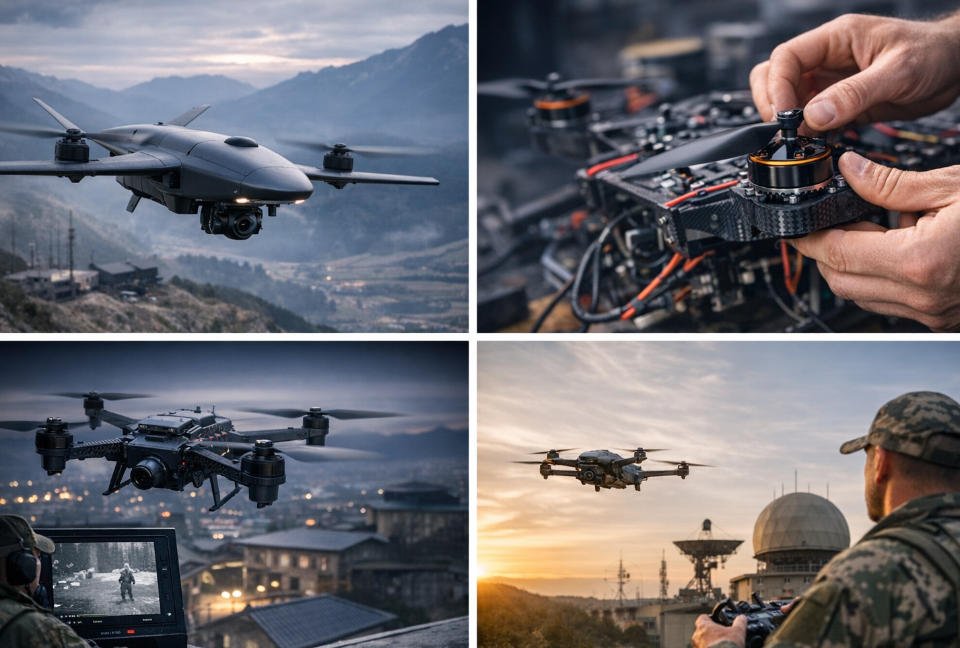
Impact on Intelligence, Surveillance, and Reconnaissance (ISR)
Silent propulsion directly influences ISR mission effectiveness, enabling UAVs to operate in environments where noise can compromise safety or mission success.
Operational Benefits
- Undetected Target Monitoring: Photographic, thermal, and signal intelligence gathering without alerting subjects.
- Covert Entry and Exit Trajectories: Silent UAVs can enter and exit contested airspace with lower risk.
- Enhanced Civil ISR: In law enforcement and disaster response, silent UAVs can operate over cities with minimal disturbance.
Tactical and Strategic Advantages
ISR missions often rely on real-time feedback, where stealth equates to strategic advantage:
- Avoidance of Detection Systems: Silent UAVs can slip past acoustic sensors, giving commanders actionable intelligence in high-risk theaters.
- Multi-Domain Integration: Noise-reduced ISR UAVs better integrate with ground teams and electronic warfare strategies.
By prioritizing silent propulsion, ISR UAV platforms become more versatile, effective, and mission-ready.
Challenges in Silent UAV Propulsion Development
While the benefits are clear, developing silent propulsion systems presents engineering, cost, and power management challenges.
Power vs. Silence Tradeoffs
- Battery Limitations: Electric propulsion depends on energy density. Batteries that support long ISR missions may add weight or reduce range.
- Hybrid Complexity: Combining power systems increases engineering complexity, maintenance demands, and production costs.
Noise vs. Performance
Engineering designs must balance stealth with adequate thrust and speed:
- Low-RPM Propellers: While quieter, they may impact max velocity and responsiveness.
- Structural Weight: Acoustic materials can add weight, demanding more powerful propulsion and careful aerodynamic design.
Despite these challenges, ongoing research and design optimization continue to push silent propulsion capabilities forward.
Future Trends in Silent UAV Propulsion
Emerging technologies promise even greater improvements in silent UAV propulsion.
1. Solid-State Batteries and Energy Storage
Next-generation solid-state batteries with higher energy densities will extend flight times and support more powerful electric propulsion without increasing noise.
2. Superconducting Motors
Superconducting electric motors could offer extremely high efficiency with minimal noise signature, ideal for heavier ISR UAVs.
3. AI-Enhanced Propulsion Control
Artificial intelligence and flight control algorithms can adapt propulsion output in real time to minimize noise based on environmental and mission variables.
4. Biomimetic Propulsion Concepts
Designs inspired by nature — such as flapping wing drones or bio-inspired airflow management — could drastically reduce both acoustic and radar signatures.
Silent UAV propulsion technologies are transforming how ISR missions are conducted. By reducing noise, increasing stealth, and improving energy efficiency, these systems redefine what is possible in surveillance, reconnaissance, and tactical operations.
From electric motors and optimized propellers to hybrid systems and acoustic shielding, the advancements discussed here represent the cutting edge of UAV power innovation.
At UAVPower, we stay at the forefront of these propulsion breakthroughs, providing insights, product solutions, and the latest in next-generation UAV power systems. Whether for military ISR integration, civil surveillance, or advanced drone development, silent UAV propulsion is a game-changing capability for today’s airborne intelligence platforms.

0 Comments