
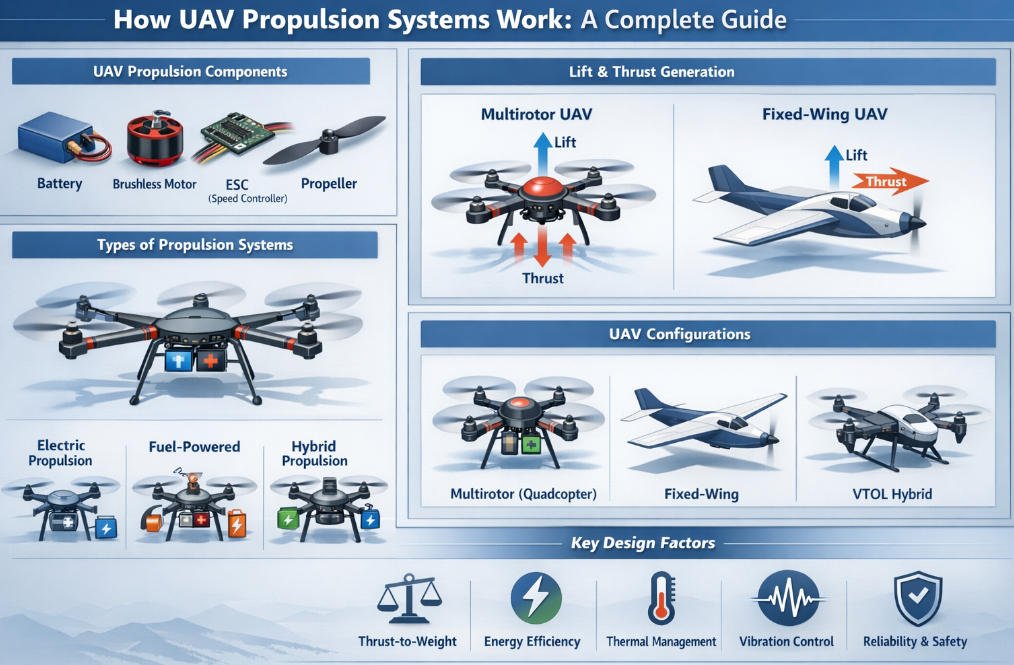
Unmanned Aerial Vehicles (UAVs), commonly known as drones, rely on propulsion systems to generate thrust, maintain stability, and achieve controlled flight. Whether used for aerial photography, agriculture, mapping, logistics, or industrial inspection, the propulsion system plays a critical role in performance, efficiency, and reliability.
This guide provides a comprehensive and technical overview of how UAV propulsion systems work, including their main components, operating principles, propulsion types, and key design considerations.
1. What Is a UAV Propulsion System?
A UAV propulsion system is the integrated set of components that converts stored energy into mechanical thrust, enabling a drone to lift off, maneuver, and remain airborne. Unlike manned aircraft, UAV propulsion systems are designed to be lightweight, compact, energy-efficient, and electronically controlled.
A complete propulsion system typically includes:
- Power source (battery, fuel, or hybrid)
- Motor or engine
- Electronic speed controller (ESC)
- Propeller or rotor
- Power distribution and control electronics
Each component must be carefully matched to achieve optimal thrust-to-weight ratio and flight efficiency.
2. Core Components of UAV Propulsion Systems
2.1 Power Source
The power source supplies energy to the propulsion system. The most common options include:
- Lithium-polymer (LiPo) batteries – widely used in electric UAVs for their high energy density
- Lithium-ion batteries – preferred for long-endurance UAVs
- Internal combustion fuel – used in large fixed-wing or heavy-lift UAVs
- Hybrid systems – combine fuel engines with electric generators for extended range
Energy selection directly affects flight time, payload capacity, and system complexity.
2.2 Motors and Engines
Electric Motors
Electric propulsion dominates small and medium UAVs due to simplicity and reliability.
- Brushless DC (BLDC) motors are standard
- High efficiency and low maintenance
- Precise electronic speed control
Internal Combustion Engines
Used primarily in long-range fixed-wing UAVs:
- Gasoline or heavy-fuel engines
- Higher energy density than batteries
- More complex maintenance requirements
2.3 Electronic Speed Controllers (ESCs)
ESCs regulate motor speed by controlling electrical power flow. They translate flight controller commands into precise motor adjustments, allowing:
- Stable hovering
- Rapid directional changes
- Smooth throttle response
Advanced ESCs support features such as regenerative braking, telemetry feedback, and thermal protection.
2.4 Propellers and Rotors
Propellers convert rotational energy into thrust by accelerating air downward or backward.
Key design variables include:
- Diameter
- Pitch
- Blade count
- Material (plastic, carbon fiber, composite)
Propeller selection significantly impacts efficiency, noise, and vibration levels.
3. How UAV Propulsion Generates Lift and Thrust
UAV propulsion systems generate thrust based on Newton’s Third Law of Motion. As the propeller pushes air downward or rearward, an equal and opposite force pushes the UAV upward or forward.
In multirotor UAVs:
- Lift is generated vertically by multiple rotors
- Directional control is achieved by varying motor speeds
In fixed-wing UAVs:
- Propulsion provides forward thrust
- Wings generate lift aerodynamically
The propulsion system must continuously adapt thrust output to maintain balance, altitude, and trajectory.
4. Types of UAV Propulsion Systems
4.1 Electric Propulsion Systems
Most common for commercial and consumer UAVs
Advantages:
- Quiet operation
- High reliability
- Low maintenance
- Precise control
Limitations:
- Limited flight time due to battery capacity
4.2 Fuel-Powered Propulsion Systems
Used in long-endurance and heavy UAVs
Advantages:
- Extended flight duration
- Higher payload capacity
Limitations:
- Mechanical complexity
- Noise and emissions
- Increased maintenance
4.3 Hybrid Propulsion Systems
Hybrid systems integrate electric motors with fuel-powered generators.
Benefits include:
- Extended range
- Improved efficiency
- Redundancy for mission-critical UAVs
Hybrid propulsion is increasingly adopted in industrial and surveillance UAV applications.
5. UAV Propulsion System Configuration by Aircraft Type
Multirotor UAVs
- Quadcopters, hexacopters, octocopters
- Vertical takeoff and landing (VTOL)
- High maneuverability
Fixed-Wing UAVs
- Single propulsion unit (tractor or pusher)
- High aerodynamic efficiency
- Long-distance missions
VTOL Hybrid UAVs
- Combine vertical lift rotors and fixed-wing propulsion
- Complex propulsion coordination
- Suitable for mapping and logistics
6. Key Design Factors in UAV Propulsion Systems
When designing or selecting a propulsion system, engineers consider:
- Thrust-to-weight ratio
- Energy efficiency
- Thermal management
- Vibration control
- Redundancy and safety
- Environmental conditions (altitude, temperature)
Professional UAV propulsion platforms, such as those discussed within technical resources like uavpower.online, often emphasize system integration and matching rather than individual component performance.
7. Efficiency and Performance Optimization
Modern UAV propulsion systems are optimized through:
- Computational fluid dynamics (CFD) for propeller design
- High-efficiency motor winding techniques
- Intelligent power management algorithms
- Lightweight structural materials
These improvements help maximize endurance, stability, and operational reliability.
8. Future Trends in UAV Propulsion
Emerging developments include:
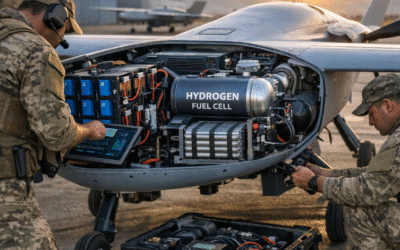
- Hydrogen fuel cell propulsion
- Distributed electric propulsion (DEP)
- AI-driven power optimization
- Ultra-low-noise propulsion systems
As UAV applications expand, propulsion technology continues to evolve toward higher efficiency and sustainability.
Conclusion
UAV propulsion systems are the foundation of drone performance, determining how efficiently and reliably a UAV can operate. By understanding the interaction between power sources, motors, controllers, and propellers, operators and engineers can make informed decisions when designing, selecting, or optimizing UAV platforms.
A well-matched propulsion system is not only critical for flight capability but also for safety, efficiency, and mission success.

0 Comments