
Unmanned Aerial Vehicles (UAVs), commonly known as drones, rely on propulsion systems as their core mechanism for generating lift, thrust, and controlled flight. Whether deployed for surveillance, mapping, agriculture, logistics, or long-endurance missions, the propulsion system directly determines a UAV’s performance, efficiency, endurance, and operational reliability.
This guide provides a comprehensive and technical overview of how UAV propulsion systems work, examining key components, propulsion types, power sources, control logic, and system-level trade-offs. It is intended for engineers, integrators, and professionals seeking a clear understanding of UAV propulsion technologies without marketing bias.
1. Fundamentals of UAV Propulsion
At its core, a UAV propulsion system converts stored energy into mechanical force to generate thrust. This thrust overcomes gravity and aerodynamic drag, enabling takeoff, hovering, maneuvering, and forward flight.
A complete propulsion system typically includes:
- Power source (battery, fuel, or hybrid system)
- Energy conversion unit (electric motor or internal combustion engine)
- Thrust generator (propeller, rotor, or ducted fan)
- Control electronics (ESC, engine control unit, or power management system)
The configuration and integration of these components vary depending on UAV type and mission requirements.
2. Key Components of a UAV Propulsion System
2.1 Power Sources
Electric Power (Batteries)
Electric propulsion systems use lithium-based batteries (Li-ion, LiPo, or LiHV) to power brushless DC motors. They are widely used due to:
- High efficiency
- Low mechanical complexity
- Minimal vibration
- Quiet operation
However, energy density limitations restrict endurance for long-range missions.
Fuel-Based Power
Fuel-powered systems use gasoline, heavy fuel, or kerosene in internal combustion engines. These systems offer:
- Higher energy density
- Extended flight duration
- Better suitability for heavy payloads
The trade-off includes increased vibration, noise, and maintenance complexity.
Hybrid Power Systems
Hybrid propulsion combines a fuel engine with an electric generator and battery buffer. The engine generates electricity, while electric motors provide propulsion. This architecture balances:
- Long endurance
- Redundancy
- Flexible power distribution
Hybrid systems are increasingly used in long-range ISR and industrial UAVs.
2.2 Motors and Engines
Electric Motors
Brushless DC (BLDC) motors dominate electric UAV propulsion. They convert electrical energy into rotational torque with high efficiency and precise control.
Key motor parameters include:
- KV rating (RPM per volt)
- Torque constant
- Efficiency curve
- Thermal limits
Internal Combustion Engines
These engines convert chemical energy into mechanical motion through combustion. They are commonly used in:
- Fixed-wing UAVs
- Heavy-lift platforms
- Long-endurance systems
Electronic engine control units (ECUs) manage fuel injection, ignition timing, and throttle response.
2.3 Propellers and Rotors
Propellers convert rotational motion into thrust by accelerating airflow. Their performance depends on:
- Diameter
- Pitch
- Blade count
- Airfoil design
- Material composition
Multirotor UAVs rely on multiple fixed-pitch propellers for lift and control, while fixed-wing UAVs use forward-facing propellers optimized for cruise efficiency.
2.4 Electronic Speed Controllers (ESCs)
ESCs regulate motor speed by adjusting voltage and current delivery based on flight controller commands. Modern ESCs provide:
- High-frequency PWM control
- Regenerative braking
- Telemetry feedback (current, voltage, RPM)
- Thermal and overcurrent protection
ESC reliability is critical for flight safety, especially in multi-motor configurations.
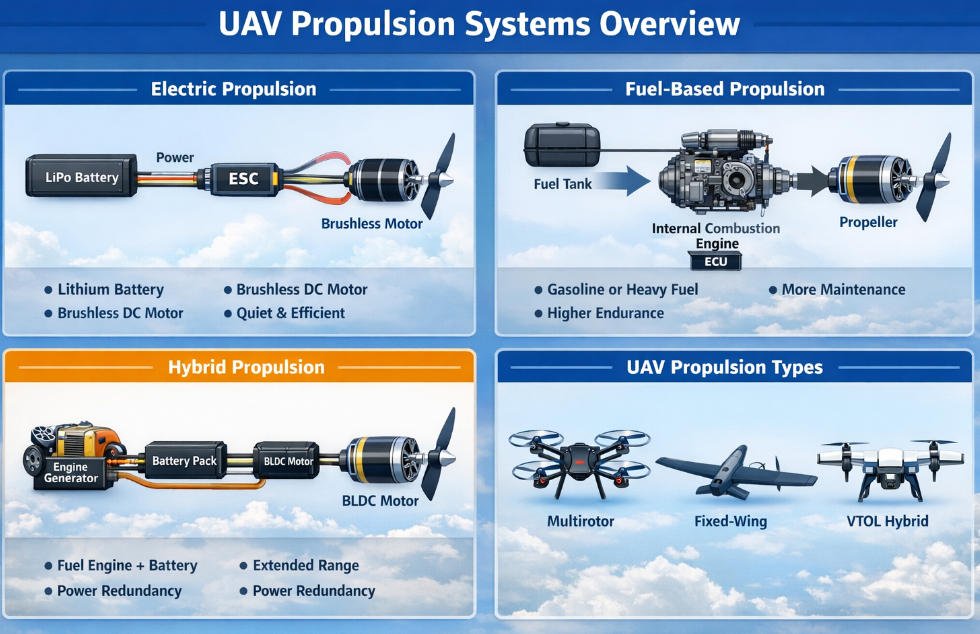
3. Types of UAV Propulsion Configurations
3.1 Multirotor Propulsion Systems
Multirotor UAVs (quadcopters, hexacopters, octocopters) rely entirely on vertical thrust. Flight control is achieved by varying motor speeds across rotors.
Advantages:
- Vertical takeoff and landing (VTOL)
- High maneuverability
- Simple mechanical design
Limitations:
- Lower energy efficiency
- Limited endurance
3.2 Fixed-Wing Propulsion Systems
Fixed-wing UAVs generate lift aerodynamically using wings, requiring forward thrust.
Advantages:
- High efficiency
- Long flight range
- Higher cruise speeds
Limitations:
- Runway or launch system required
- Limited hover capability
3.3 VTOL and Hybrid Configurations
VTOL fixed-wing UAVs combine multirotor lift motors with forward propulsion systems. This architecture allows:
- Vertical takeoff and landing
- Efficient forward cruise
Such systems are mechanically and electrically complex but offer unmatched operational flexibility.
4. Propulsion System Control and Integration
4.1 Flight Controller Interface
The flight controller acts as the central coordinator, translating navigation and stabilization commands into propulsion outputs. It manages:
- Throttle commands
- Motor mixing algorithms
- Redundancy logic
- Fail-safe responses
4.2 Power Management and Redundancy
Advanced UAV propulsion systems integrate:
- Power distribution units (PDU)
- Battery management systems (BMS)
- Engine generators and DC buses
These components ensure stable voltage delivery, fault isolation, and system-level efficiency.
5. Performance Factors Influenced by Propulsion Systems
The propulsion system directly affects:
- Maximum takeoff weight (MTOW)
- Flight endurance
- Payload capacity
- Noise and vibration levels
- Thermal management
- Operational reliability
Optimizing propulsion requires balancing efficiency, weight, redundancy, and mission profile.
6. Future Trends in UAV Propulsion
Emerging developments in UAV propulsion include:
- High-efficiency hybrid-electric architectures
- Advanced fuel-injection and ignition systems
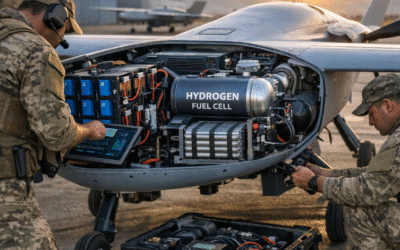
- Hydrogen and fuel-cell propulsion
- Smart motor controllers with AI-based diagnostics
- Lightweight composite propellers
These innovations aim to extend endurance, reduce emissions, and improve system intelligence.
Conclusion
UAV propulsion systems are a critical determinant of aerial performance, mission capability, and system reliability. By understanding how energy is generated, converted, and controlled within different propulsion architectures, engineers and operators can make informed decisions tailored to specific operational needs.
As UAV applications continue to expand, propulsion technology will remain a central focus for innovation, efficiency, and scalability across both commercial and industrial domains.

0 Comments