
Long-endurance unmanned aerial vehicles (UAVs) play a critical role in applications such as intelligence, surveillance and reconnaissance (ISR), border patrol, environmental monitoring, communications relay, and industrial inspection. Achieving extended flight duration—ranging from several hours to multiple days—depends fundamentally on propulsion system design. A well-engineered propulsion system must balance efficiency, reliability, power density, fuel consumption, and integration with the airframe and mission payload.
This article provides a technical overview of UAV propulsion system design strategies for long-endurance drones, focusing on engine selection, energy conversion, system architecture, and optimization principles used in modern unmanned aerial systems (UAS).
Key Design Objectives for Long-Endurance UAV Propulsion
Long-endurance propulsion systems are designed around several core objectives:
- Maximum energy efficiency at cruise power
- High specific energy of the energy source (fuel or battery)
- Stable operation over extended duty cycles
- Low system mass and parasitic losses
- High reliability and fault tolerance
- Compatibility with hybrid or modular configurations
Meeting these objectives requires a system-level design approach rather than optimization of individual components alone.
Propulsion System Architectures for Long-Endurance UAVs
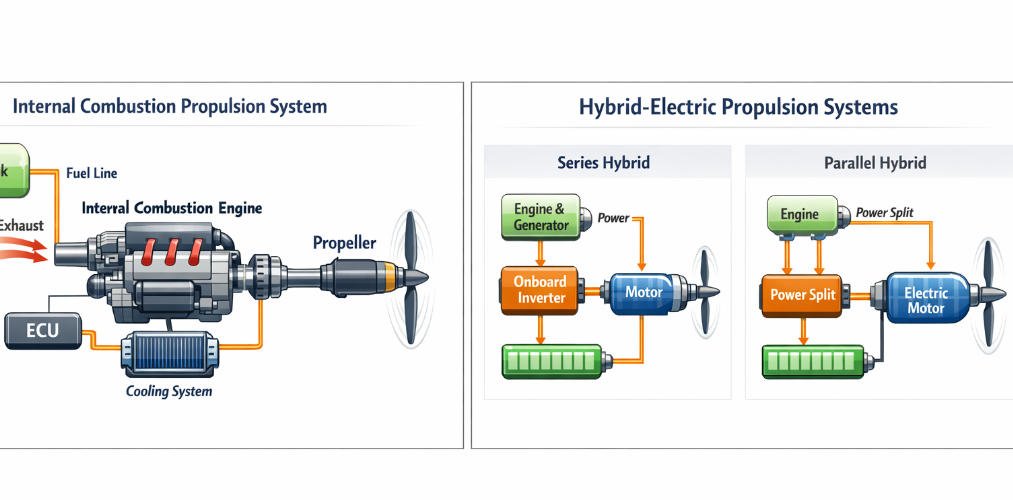
1. Direct Internal Combustion Propulsion
In this configuration, an internal combustion engine (ICE) directly drives the propeller.
Advantages:
- High energy density of liquid fuels
- Long operating time with minimal refueling weight
- Mature mechanical technology
Design Considerations:
- Engine efficiency at cruise RPM
- Vibration isolation and structural fatigue
- Thermal management for continuous operation
- Fuel mixture control at varying altitudes
This architecture is commonly used in fixed-wing UAVs with endurance requirements exceeding 10–20 hours.
2. Hybrid-Electric Propulsion Systems
Hybrid systems combine an internal combustion engine with an electric motor and energy storage system.
Common Hybrid Modes:
- Series hybrid: Engine drives a generator; propulsion is fully electric
- Parallel hybrid: Engine and motor both contribute to thrust
- Range-extender configuration: Engine operates at optimal efficiency to recharge batteries
Advantages for Long-Endurance UAVs:
- Engine can operate at its most efficient load point
- Reduced fuel consumption during loiter phases
- Improved redundancy and mission flexibility
Challenges:
- Increased system complexity
- Power management and control strategy optimization
- Weight trade-offs between fuel, batteries, and electronics
3. Electric Propulsion (Limited-Endurance Use)
Pure electric propulsion is generally unsuitable for very long endurance due to battery energy density limitations. However, it may be used in:
- High-altitude solar-assisted UAVs
- Short-duration silent mission phases
- Hybrid takeoff and landing operations
Engine Selection Criteria for Long-Endurance UAVs
Selecting the appropriate engine is a critical step in propulsion system design.
Key Parameters:
- Specific fuel consumption (SFC)
- Power-to-weight ratio
- Continuous rated power
- Altitude performance
- Fuel compatibility (gasoline, heavy fuel, multi-fuel)
Engine Types Commonly Used:
- Piston engines: High efficiency, suitable for steady cruise
- Rotary engines: Compact size, smooth operation
- Small turbine engines: High power density but lower efficiency at low throttle
For endurance-focused UAVs, piston and rotary engines are typically favored due to lower SFC and better part-load efficiency.
Energy Management and System Optimization
Power Matching
The propulsion system must be matched to the UAV’s aerodynamic characteristics:
- Propeller diameter and pitch optimized for cruise
- Engine operating near peak efficiency at loiter speed
- Avoidance of oversizing, which increases fuel burn
Thermal Management
Extended operation generates continuous heat:
- Air or liquid cooling systems must be sized for steady-state conditions
- Exhaust heat can be recovered in hybrid configurations
- Temperature stability improves engine longevity
Weight and Balance Optimization
- Fuel placement affects center of gravity over long missions
- Hybrid systems must account for battery degradation over time
- Structural integration reduces unnecessary mounting mass
Reliability and Redundancy in Long-Endurance Missions
Long-duration flights require propulsion systems with:
- Proven endurance testing
- Redundant ignition or power electronics
- Real-time health monitoring (RPM, temperature, vibration)
- Fail-safe modes for partial power operation
Predictive maintenance strategies are increasingly integrated into propulsion system design to reduce mission risk.
Integration with Mission Profiles
Propulsion systems must support different flight phases:
- High power for takeoff and climb
- Ultra-efficient cruise for loiter
- Low-noise or low-thermal modes for sensitive missions
Hybrid and modular propulsion systems offer adaptability across varying mission requirements without redesigning the entire platform.
Future Trends in Long-Endurance UAV Propulsion
Key developments include:
- Advanced hybrid control algorithms
- Higher-efficiency generators and motors
- Improved heavy-fuel engine technologies
- Integration with solar and alternative energy sources
- Digital twins for propulsion system optimization
These innovations continue to push endurance limits while improving reliability and operational flexibility.
Designing propulsion systems for long-endurance UAVs is a multidisciplinary engineering challenge involving thermodynamics, aerodynamics, structural integration, and energy management. The most effective solutions prioritize efficiency at cruise, system reliability, and adaptability to mission demands. As UAV applications expand, propulsion system design will remain a defining factor in achieving greater endurance, range, and operational value.

0 Comments