
Drone flight time is one of the most critical performance factors for both commercial and industrial UAV applications. Whether used for aerial photography, surveying, agriculture, inspection, or logistics, longer flight time directly translates into higher efficiency, lower operating costs, and expanded mission capability. However, flight time is fundamentally limited by power system design.
This article explores proven power system strategies for improving drone flight time, focusing on energy storage, propulsion efficiency, power management, and system-level optimization. These strategies are widely adopted in professional drone engineering and deliver measurable performance improvements.
Understanding the Power System’s Role in Drone Flight Time
A drone’s flight time is determined by the balance between available energy and total power consumption. The power system includes:
- Battery or energy source
- Motors and propellers
- Electronic speed controllers (ESCs)
- Power distribution and voltage regulation
- Flight controller power management
Optimizing flight time requires improving energy density while simultaneously reducing power losses across the system.
Battery Technology Selection and Optimization
Choosing the Right Battery Chemistry
Battery chemistry has the largest impact on drone flight time.
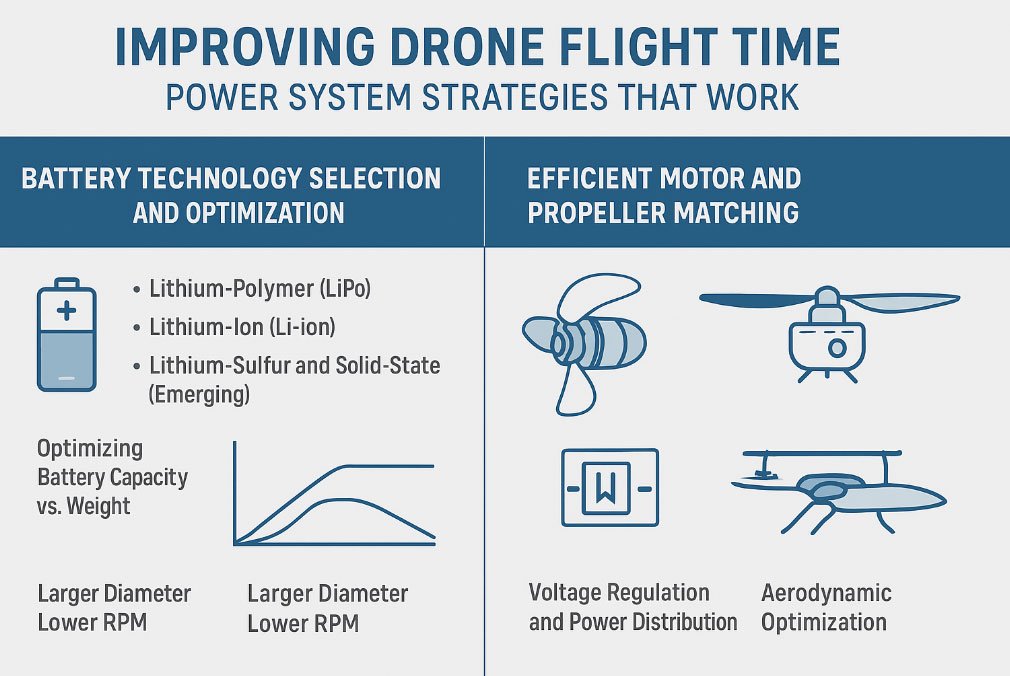
- Lithium-Polymer (LiPo): High discharge rates, lightweight, widely used in multirotor drones
- Lithium-Ion (Li-ion): Higher energy density, longer flight time, lower discharge rates, ideal for long-endurance drones
- Lithium-Sulfur and Solid-State (Emerging): Promising future technologies with higher theoretical energy density
For endurance-focused drones, Li-ion batteries often outperform LiPo by delivering longer flight time at reduced weight.
Optimizing Battery Capacity vs. Weight
Simply increasing battery capacity does not always improve flight time. Excess weight raises thrust requirements and increases power draw.
Best practices include:
- Selecting the highest energy density battery within safe weight limits
- Using multi-cell configurations to reduce current draw
- Avoiding overcapacity that reduces net efficiency
Efficient Motor and Propeller Matching
High-Efficiency Motors
Motor efficiency directly affects how much electrical energy is converted into thrust.
Key motor selection factors:
- Lower KV motors for endurance applications
- High-quality bearings to reduce friction losses
- Optimized winding design for efficiency at cruising throttle
Propeller Design for Endurance
Propellers are often underestimated in power system optimization.
Effective strategies include:
- Larger diameter, lower RPM propellers
- High aspect ratio blades for improved lift efficiency
- Lightweight composite or carbon fiber materials
Proper motor-propeller matching can improve flight time by 10–25% without changing battery capacity.
Power Management and ESC Optimization
High-Efficiency ESCs
Modern ESCs play a critical role in minimizing power loss.
- Use FOC (Field-Oriented Control) ESCs for smoother and more efficient motor control
- Choose ESCs with low internal resistance
- Enable active braking only when necessary
Voltage Regulation and Power Distribution
Poor voltage regulation leads to energy waste and unstable flight performance.
Optimization tips:
- Minimize wire length and resistance
- Use high-quality connectors and solder joints
- Avoid unnecessary voltage conversions
Efficient power distribution ensures that more battery energy is used for propulsion rather than heat loss.
Reducing Overall Power Consumption
Airframe Weight Reduction
Every gram saved reduces continuous power demand.
Effective methods:
- Use lightweight frame materials such as carbon fiber
- Optimize structural design for strength-to-weight ratio
- Eliminate redundant components
Aerodynamic Optimization
Improved aerodynamics reduce drag and required thrust.
Key considerations:
- Streamlined fuselage design
- Enclosed wiring and smooth surfaces
- Optimized landing gear or retractable systems
Even minor aerodynamic improvements can significantly extend drone flight time, especially for forward-flight UAVs.
Advanced Power System Strategies
Hybrid Power Systems
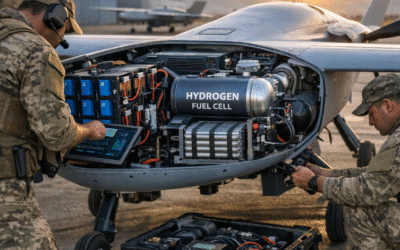
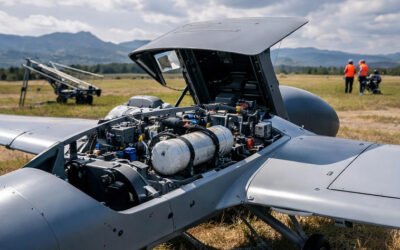
Hybrid systems combine batteries with:
- Fuel cells
- Internal combustion generators
- Solar-assisted charging
These systems dramatically extend flight time for long-range and industrial drones, sometimes achieving hours instead of minutes.
Intelligent Power Management Software
Modern flight controllers can dynamically manage power consumption.
Capabilities include:
- Adaptive throttle control
- Real-time current monitoring
- Energy-aware flight path optimization
Smart software ensures that power is consumed only when necessary.
Balancing Performance, Safety, and Flight Time
While maximizing drone flight time is important, it must never compromise safety.
Key safety considerations:
- Avoid deep battery discharge
- Maintain thermal stability
- Ensure redundancy for critical power components
A well-designed power system balances endurance with reliability and regulatory compliance.
Conclusion
Improving drone flight time requires a holistic power system strategy rather than a single hardware upgrade. By optimizing battery technology, motor-propeller efficiency, ESC performance, weight, aerodynamics, and intelligent power management, drone manufacturers and operators can achieve substantial gains in endurance.
These proven power system strategies not only extend flight time but also improve overall drone performance, operational efficiency, and long-term reliability.

0 Comments