
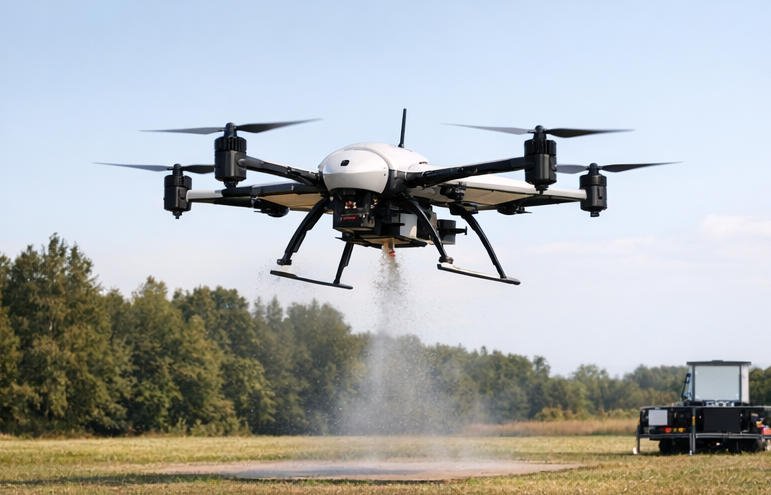
Selecting the appropriate propulsion system is a foundational decision in unmanned aerial vehicle (UAV) design. The propulsion architecture directly influences endurance, payload capacity, efficiency, reliability, and operational flexibility. Among UAV platforms, fixed-wing UAVs and VTOL (Vertical Takeoff and Landing) UAVs present fundamentally different aerodynamic and mission requirements, leading to distinct propulsion system choices.
This article provides a technical comparison of propulsion system selection criteria for fixed-wing and VTOL UAVs, focusing on power sources, propulsion architectures, efficiency trade-offs, and mission-driven design considerations. The goal is to support UAV developers, system integrators, and aerospace engineers in making informed propulsion decisions based on real operational needs rather than marketing claims.
1. Fundamental Differences in Flight Characteristics
Fixed-Wing UAVs
Fixed-wing UAVs rely on aerodynamic lift generated by forward motion over the wings. Once airborne, they are inherently energy-efficient and well-suited for long-duration and long-range missions.
Key characteristics:
- Continuous forward flight
- Lift generated aerodynamically
- High cruise efficiency
- Limited low-speed maneuverability
- Requires runway, launcher, or recovery system
VTOL UAVs
VTOL UAVs combine vertical lift capability with forward flight, enabling operations in confined environments without runways.
Key characteristics:
- Vertical takeoff and landing
- Hover and low-speed maneuvering
- Higher energy demand during takeoff and hover
- Increased mechanical and control complexity
- Greater operational flexibility
These flight differences impose fundamentally different propulsion system requirements.
2. Propulsion System Requirements by Platform Type
Fixed-Wing UAV Propulsion Requirements
Fixed-wing UAV propulsion systems are optimized for:
- High efficiency at steady cruise
- Low specific fuel consumption (SFC)
- Stable and continuous power output
- Lightweight power-to-thrust ratio
Common propulsion configurations include:
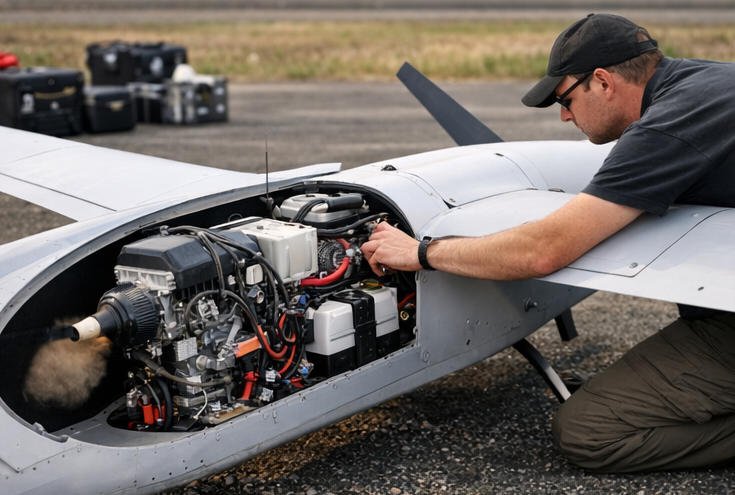
- Internal combustion engines (2-stroke or 4-stroke)
- Heavy-fuel engines (gasoline/diesel/kerosene)
- Hybrid propulsion systems (engine + generator + electric motor)
- Pure electric systems for small UAVs
For medium- and long-endurance platforms, fuel-based propulsion remains dominant due to superior energy density compared to batteries.
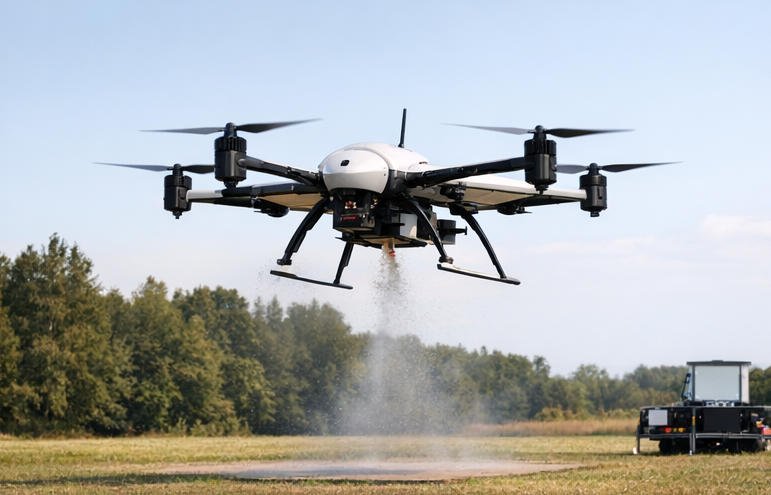
VTOL UAV Propulsion Requirements
VTOL UAVs face a more complex propulsion challenge. The system must support:
- High instantaneous power for vertical lift
- Sustained power for hover
- Efficient propulsion during forward flight
- Redundancy and fault tolerance
Typical VTOL propulsion architectures include:
- Multi-motor electric propulsion (distributed lift)
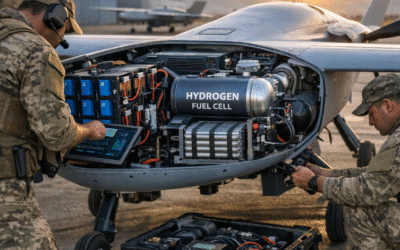
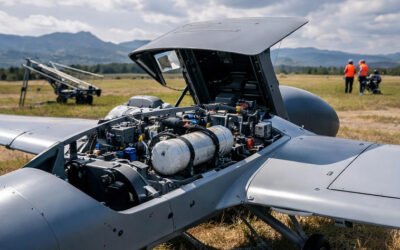
- Hybrid VTOL systems with fuel engines as range extenders
- Separate lift and cruise propulsion units
- Tilt-rotor or tilt-wing propulsion configurations
Energy consumption during vertical flight is significantly higher than cruise, making power density and thermal management critical design factors.
3. Power Source Comparison: Fuel vs Electric vs Hybrid
Fuel-Based Propulsion Systems
Advantages:
- High energy density
- Long endurance capability
- Stable power output for cruise
- Well-suited for fixed-wing UAVs
Limitations:
- Mechanical complexity
- Higher vibration and noise
- Emissions and maintenance requirements
Fuel engines are commonly selected for fixed-wing UAVs operating beyond several hours of endurance.
Electric Propulsion Systems
Advantages:
- High torque at low RPM
- Precise thrust control
- Low acoustic signature
- Minimal mechanical complexity
Limitations:
- Limited energy density of batteries
- Reduced endurance for larger UAVs
- Performance degradation in cold environments
Electric propulsion is dominant in small UAVs and VTOL lift systems, where control precision and responsiveness are critical.
Hybrid Propulsion Systems
Hybrid propulsion combines fuel engines with electric generators and motors.
Advantages:
- Extended endurance
- Optimized engine operating point
- High peak power availability
- Improved redundancy
Hybrid systems are increasingly selected for:
- Long-endurance VTOL UAVs
- Fixed-wing UAVs with additional power demands
- ISR and logistics platforms requiring flexibility
Hybrid architectures effectively bridge the gap between endurance and vertical lift capability.
4. Propulsion Architecture Considerations
Fixed-Wing UAV Architectures
Common layouts include:
- Tractor (front-mounted propeller)
- Pusher (rear-mounted propeller)
- Twin-engine configurations for redundancy
- Engine-driven generators for onboard power
Design emphasis is placed on:
- Cruise efficiency
- Propeller matching
- Cooling and vibration isolation
VTOL UAV Architectures
VTOL platforms require more complex propulsion integration:
- Distributed electric lift motors
- Separate lift and cruise systems
- Power management units for mode transitions
- Redundant motor and controller layouts
Key engineering challenges:
- Weight penalty of multiple motors
- Power distribution efficiency
- Smooth transition between hover and cruise
- Failure tolerance during vertical flight
5. Mission-Driven Propulsion Selection
The optimal propulsion system is determined primarily by mission profile, not platform type alone.
| Mission Requirement | Preferred Propulsion |
|---|---|
| Long-range ISR | Fuel or hybrid fixed-wing |
| Confined-area operations | Electric or hybrid VTOL |
| Heavy payload delivery | Hybrid propulsion |
| Low acoustic signature | Electric propulsion |
| Ultra-long endurance | Fuel-based systems |
Early propulsion selection reduces system redesign risk and improves overall UAV performance.
6. Reliability, Maintenance, and Lifecycle Considerations
- Fixed-wing fuel engines typically offer long operational hours but require scheduled maintenance.
- Electric propulsion systems reduce mechanical wear but depend heavily on battery health.
- Hybrid systems introduce complexity but can improve mission reliability through redundancy.
Lifecycle cost analysis should include:
- Fuel or energy consumption
- Maintenance intervals
- Component replacement cycles
- Operational downtime
Propulsion system selection for fixed-wing versus VTOL UAVs is a multi-dimensional engineering decision involving aerodynamics, energy management, mission profile, and system integration. Fixed-wing UAVs prioritize cruise efficiency and endurance, while VTOL UAVs demand high power density and flexible propulsion architectures.
Fuel-based, electric, and hybrid propulsion systems each serve distinct roles within UAV design. A well-matched propulsion system enhances performance, reliability, and operational effectiveness while minimizing unnecessary complexity.
By focusing on mission-driven requirements rather than platform trends, UAV developers can achieve optimal propulsion system selection for both fixed-wing and VTOL applications.

0 Comments