
Unmanned Aerial Vehicles (UAVs) rely on propulsion systems that directly determine flight endurance, payload capacity, reliability, and operational flexibility. Unlike manned aircraft, UAV engine selection must account for autonomous operation, mission-specific power demands, and strict efficiency constraints.
This article provides a technical overview of the four primary UAV engine types—piston engines, rotary (Wankel) engines, turbine engines, and hybrid propulsion systems—highlighting their working principles, performance characteristics, advantages, limitations, and typical applications.
1. Piston Engines for UAVs
Working Principle
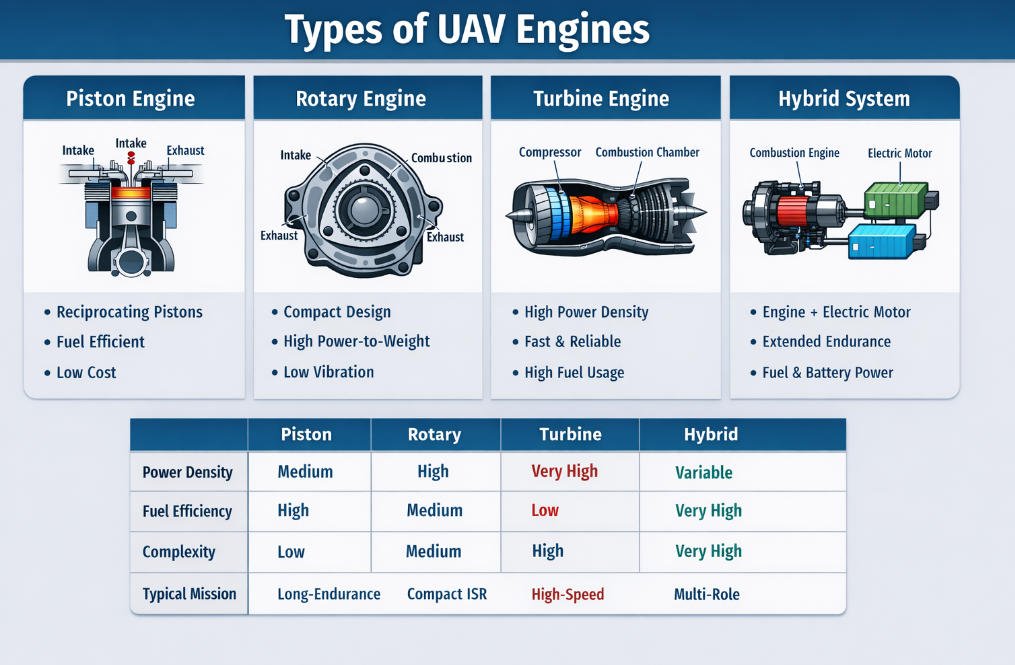
Piston engines operate using a reciprocating combustion cycle, typically based on two-stroke or four-stroke internal combustion designs. Fuel combustion drives pistons connected to a crankshaft, producing mechanical power for propeller-driven UAVs.
Key Characteristics
- Power output: Low to medium (typically 1–100+ kW)
- Fuel types: Gasoline, heavy fuel (Jet-A, JP-8)
- Cooling: Air-cooled or liquid-cooled
- Configuration: Single-cylinder to multi-cylinder
Advantages
- High fuel efficiency at cruise conditions
- Mature and well-understood technology
- Relatively low manufacturing and maintenance costs
- Good suitability for long-endurance missions
Limitations
- Higher vibration levels compared to rotary engines
- Mechanical wear due to multiple moving parts
- Limited power-to-weight ratio for high-speed UAVs
Typical Applications
- Fixed-wing surveillance UAVs
- Long-endurance ISR platforms
- Agricultural and mapping drones
- Medium-altitude UAV missions
2. Rotary (Wankel) Engines for UAVs
Working Principle
Rotary engines use a triangular rotor rotating inside an epitrochoidal housing, completing intake, compression, combustion, and exhaust cycles in a continuous motion without reciprocating pistons.
Key Characteristics
- Compact design with fewer moving parts
- High power-to-weight ratio
- Smooth operation with low vibration
- Capable of high RPM output
Advantages
- Lightweight and compact footprint
- Reduced vibration, ideal for sensitive sensors
- High specific power for UAV size constraints
- Simplified mechanical structure
Limitations
- Lower fuel efficiency than piston engines
- Higher exhaust temperatures
- More complex sealing requirements
- Increased fuel consumption at partial loads
Typical Applications
- Tactical ISR UAVs
- VTOL fixed-wing hybrid platforms
- High-speed and medium-payload drones
- Applications requiring compact engine integration
3. Turbine Engines for UAVs
Working Principle
Turbine engines generate thrust or shaft power through continuous combustion, driving a turbine connected to a compressor and output shaft or jet nozzle.
Key Characteristics
- Types: Turbojet, turbofan, turboshaft
- Extremely high power-to-weight ratio
- Operates efficiently at high altitudes
- Uses aviation-grade fuels (Jet-A, JP-8)
Advantages
- Exceptional power density
- Reliable operation at high speeds and altitudes
- Low vibration compared to piston engines
- Continuous power delivery
Limitations
- High fuel consumption at low speeds
- Expensive manufacturing and maintenance
- Complex starting and control systems
- Less efficient for loitering missions
Typical Applications
- High-speed UAVs
- Target drones
- Large MALE and HALE platforms
- Military and experimental UAV systems
4. Hybrid UAV Propulsion Systems
Working Principle
Hybrid UAV engines combine internal combustion engines with electric motors and energy storage systems. The combustion engine acts as a generator, propulsion source, or range extender, while electric motors provide flexible power distribution.
Common Hybrid Architectures
- Series hybrid (engine generates electricity)
- Parallel hybrid (engine and motor both drive propeller)
- Range extender configuration
- Generator-based power supply for electric propulsion
Advantages
- Extended flight endurance
- Optimized fuel efficiency across mission phases
- Reduced acoustic and thermal signatures
- Flexible power management for sensors and payloads
Limitations
- Increased system complexity
- Higher integration and control requirements
- Added weight from batteries and power electronics
- More advanced BMS and control logic required
Typical Applications
- Long-endurance ISR missions
- VTOL fixed-wing UAVs
- Power-intensive payload platforms
- Multi-role industrial UAVs
Comparative Overview of UAV Engine Types
| Engine Type | Power Density | Fuel Efficiency | Complexity | Typical Mission |
|---|---|---|---|---|
| Piston | Medium | High | Low | Long-endurance |
| Rotary | High | Medium | Medium | Compact ISR |
| Turbine | Very High | Low (low-speed) | High | High-speed |
| Hybrid | Variable | Very High | Very High | Multi-role |
How to Choose the Right UAV Engine
Selecting the optimal UAV engine depends on several mission-critical factors:
- Endurance vs. speed requirements
- Payload weight and onboard power demand
- Operating altitude and environmental conditions
- Fuel availability and logistics
- Noise, vibration, and thermal constraints
- Maintenance and lifecycle cost considerations
There is no universal solution; engine selection must align with mission objectives and system-level optimization.
Future Trends in UAV Engine Development
UAV propulsion technology continues to evolve with trends such as:
- Increased adoption of heavy-fuel engines
- Advanced hybrid-electric architectures
- Improved thermal efficiency and emissions control
- Integration with intelligent power management systems
- Modular engine platforms for scalable UAV designs
These developments aim to balance efficiency, reliability, and operational flexibility in next-generation unmanned aerial systems.

0 Comments